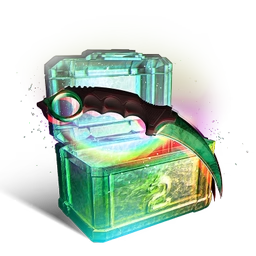
Unboxing the Thrill: Navigating the World of CSGO Case Openings

Few phenomena in gaming have influenced internet culture, the economy, and shooter games quite like the CS:GO case (now continuing into Counter-Strike 2). Introduced back in August 2013 with the “Arms Deal” update, weapon cases transformed Counter-Strike from a purely skill-based tactical shooter into a virtual trading card game wrapped in an adrenaline-fueled lottery.
Whether players are looking to flex rare knife skins or simply want a cool look for their AK-47, understanding how CS:GO cases work is essential for anyone diving into the game’s massive economy.
What is a CS:GO Case?
A CS:GO case is a virtual container holding a random weapon skin, sticker, or glove. To open a case, players need two things:
- The Case Itself: Dropped randomly during weekly gameplay, earned through active operations, or purchased on the Steam Community Market.
- A Key: Purchased in-game for a flat rate of £2.50 GBP (or local currency equivalent).
Once unlocked, the animation spins through a visual roulette of items before landing on the player’s reward. The item is then added to their Steam Inventory, where it can be kept, traded, sold, or used in-game.
Drop Rates and Odds: What Are the Chances?
Transparency regarding loot box odds is a heavily regulated topic globally. Valve officially publishes the baseline probabilities for opening a case.
Here is the breakdown of what players can realistically expect to pull from a standard weapon case:
| Rarity Tier | Color Code | Approximate Drop Rate |
|---|---|---|
| Mil-Spec (Common) | Blue | ~79.92% |
| Restricted (Uncommon) | Purple | ~15.98% |
| Classified (Rare) | Pink | ~3.20% |
| Covert (Mythical) | Red | ~0.64% |
| Special (Exceedingly Rare) | Gold (Knives/Gloves) | ~0.26% |
Note on StatTrak: Any weapon skin pulled from a case has roughly a 10% chance of being “StatTrak,” a special variant that tracks the number of kills made with that specific weapon.
The Economics of CS:GO Cases
The market surrounding weapon cases is entirely player-driven. Valve sets the price of keys, but the supply and demand of cases and skins dictate the secondary market.
Why Do Case Prices Rise?
- Discontinuation: When Valve releases a new operation or shifts a case to the “rare drop pool,” the active supply drops significantly.
- Nostalgia and Popularity: Cases containing iconic skins (like the AWP | Asiimov or AK-47 | Redline) remain in high demand.
- Hype Events: Major esports tournaments often bring spikes in player counts, driving up case openings.
Types of Case Openers
- The Casual Opener: Opens a case or two every payday for the thrill of the gamble.
- The Investor: Buys hundreds of cheap, active-drop cases and holds them for years, betting that the price will appreciate once they are discontinued.
- The Market Purist: Avoids opening cases entirely, preferring to buy specific skins directly from the Steam Market or third-party trading sites to avoid losing money on unboxings.
Tips for Navigating the Case Economy
For players looking to interact with the case and skin ecosystem safely and smartly, several best practices should be considered:
- Treat it as Entertainment, Not an Investment: Statistically, the house always wins. Opening cases carries a high financial risk with a low return rate.
- Buy Direct When Possible: If a player wants a specific skin, purchasing it directly from the Community Market is almost always cheaper than trying to unbox it.
- Beware of Scams: The trading community is heavily targeted by phishers, fake middlemen, and API scams. Never log into third-party sites with unknown credentials.
- Understand Wear Ratings: Skins come in different conditions (Factory New, Minimal Wear, Field-Tested, Well-Worn, and Battle-Scarred). These conditions drastically affect the price of the item.
Frequently Asked Questions (FAQ)
1. Can I still get weapon cases drops in Counter-Strike 2 (CS2)?
Yes. The drop system transitioned directly from CS:GO to CS2. Players receive up to a couple of random item/case drops per week upon leveling up their profile, alongside rewards during active gameplay events.
2. Are cases rigged?
No. The odds are mathematically fixed according to Valve’s published percentages. Every case opening is an independent statistical event, meaning previous rolls do not influence future ones.
3. What is the most expensive CS:GO case?
Older, discontinued cases—such as the Operation Bravo Case or the Weapon Case #1—often command very high prices on the Steam Market due to their extreme scarcity and the iconic items they contain (like the original set of knife finishes).
4. Can I sell items I get from cases for real cash?
While you can sell items on the Steam Community Market, those funds remain in your Steam Wallet and cannot be legally withdrawn as cash directly through Steam. However, many players use reputable third-party marketplaces to trade skins for cryptocurrency or cash-out options (proceed with caution and research platform safety).
5. Do I need to buy a key to open souvenir packages?
No! Souvenir Packages, which drop during official esports Majors, do not require a key to open. However, you cannot control what match or player signature you receive unless you purchase specific packages directly.
Try Case Opening on CS2Skin to uncover CS2 skin possibilities, enjoy a smooth experience, and chase standout virtual drops.
